Site founded Sept. 1, 2000. We passed 3 million page views on Feb. 10, 2009
These home pages remain free of any charge. We need donations or subscriptions to continue.
Please pass on this website link to your family, relatives, friends and clients.

(S and N Railroad)

Skagit River Journal

of History & Folklore
Free Home Page Stories & Photos
The most in-depth, comprehensive site about the Skagit

Covers from British Columbia to Puget Sound. Counties covered: Skagit, Whatcom, Island, San Juan, Snohomish & BC. An evolving history dedicated to committing random acts of historical kindness
Noel V. Bourasaw, editor (bullet) 810 Central Ave., Sedro-Woolley, Washington, 98284
Home of the Tarheel Stomp (bullet) Mortimer Cook slept here & named the town Bug

(Click to send email)

Mortimer Cook, Bug and Sedro


(Cook store and house)
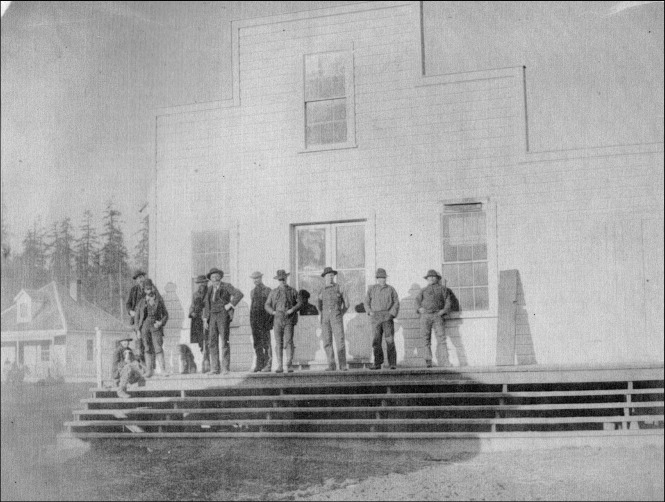
      Mortimer Cook is the man standing, fourth from the left, in front of the general store, which stood appropriately on Water street, just upslope from his wharf. The house that pioneer David Batey also built is to the left. These are the only known photos of the store and house. We hope that a reader will find in their family collections other photos of the Cook property and early Sedro.

      Yes, Virginia. Sedro was originally named Bug. The little burg on the north shore of the Skagit River was named that way by founder Mortimer Cook within a year after he began claiming and buying land in June 1884. He bought outright and obtained options on patches of timber in the swampy areas that now encompass Sedro-Woolley, and more timberland all the way up the hill three miles north that eventually became known as Duke's Hill. Deanna Ammons, the historian of Clear Lake, found the only known newspaper reference of that time to the naming of Bug and Sedro, and we share it now along with other contemporary stories.
      At first, he lived here alone, boarding with pioneer David Batey, who then lived with his wife, Georgianna, and his stepsons in a log house somewhere near the river on his homestead that lay to the west about halfway between Cook's townsite and the town of Sterling, the earliest upriver town in Skagit County. Batey later built a large combination house/hotel/hospital on the bench of land that is now the elbow of Rhodes road. Batey built a general store for Cook and a house where Riverfront Park stands today. Cook's wife and teenage daughters joined him a year later on June 22, 1885, after the house was ready and after the town had a proper name. You can read more about the family in the Journal introduction to the Cooks [link repaired]. Meanwhile, you will find below the four known references to Bug/Sedro, which all give different perspective on the name, and then we will try to tie it all up in a tidy package at the end.


Skagit News, May 12, 1885
Sedro, Washington territory
      The residence of Mortimer Cook at Sedro, three miles above Sterling post office, received the finishing touch of paint to-day, May 2d, by David Batey, contractor. This is a neat little one-story structure of the Spanish-Californian style; main building 28x28 feet, comprising two bedrooms, dining, sitting room, with kitchen and wood shed in the rear, 12x12 and 12x10 respectively. One bedroom and storeroom in the attic, piazza running full width of front, hip-roofed, with one dormer window front and rear. The ceiling to all of the rooms and piazza and woodshed are painted sky-blue; the inside finish is plain, but neat; the doors are painted white, California redwood panels, oiled fireplace in sitting room with a neat cedar mantle, oiled sides of fireplace and hearth, chimney painted brick color.
      The walls inside are all neatly papered; the balance of the wood work receives two coats of paint, pure white lead; the house is in a nice opening of 1 1/2 acres, seeded with grass , and a nice picket fence to add to its finish and home-like appearance.
      Mr. Cook's family is expected soon from the orange kingdom, California, where has been their home for many years, to be the occupants of this lovely little cottage upon the banks of the beautiful and grand old Skagit River where its waters forever flow. May they hail its beauties with much joy, and may their lives be long and prosperous in their new undertaking — and that they may drink of the sublime quietude and peace and the glories of the forest where the threes stand so lofty and so great, towering to the very heavens. Surely the canopy of heaven never spread its mantle over a more sublime scene than can be obtained at that place, near mountains towering just in front and the silvery stream dancing with her laughing waters t the base, and this beautiful love of a home just a little upon the rise, upon the opposite shore, surrounded in the background with these ever green and lofty evergreen trees, that shade this green space the year round; surely it deserves the most cultured touch of the artist's skill to do this romantic scene justice.
      May Mr. and Mrs. Cook and daughters be happily received in our midst and may we all be benefited by their presence, as adding to the population of our immediate neighborhood is the wish of all.
      David Batey has also taken a contract for building a store 36x48 for Mr. Cook, at the landing near his residence, of which the foundation was commenced May 2d, and he expects, one among others, to supply all wants of the people that are settling up this fertile valley.
      (Skagit News editorial note in typescript at bottom: "we understood the place was to be called Bug. Has it been changed?")


Washington magazine, August 1890
      This excerpt from the August 1890 issue of The Washington Magazine provides the earliest explanation of the moniker that Mortimer Cook originally attached to his settlement of a dozen or so hardy souls. Later settler memoirs differ slightly but this version helps us understand the evolution of one of oddest town names in the US.
      Mr. Cook, being a man of ingenious and original turn of mind, determined to give the future town a name which would be at once unique and without duplicate. Mr. Cook spent several days, so tradition tells us, earnestly scrutinizing the names of the various post offices of the United States, together with the "Blue Book," but among them all he is reported to have found no name in the universe which had not been chosen, and some times, for the hundredth time, with the exception of one, which, on account of its originality, its concise and euphonious spelling he adopted directly. That was Bug.
      The post office superintendent wrote Mr. Cook congratulating him, and approving his choice; and things might have gone serenely on for an indefinite period had not an unforeseen contingency arisen which might have resulted disastrously, but was happily averted. Letters began to arrive addressed thus: Mrs. Jno. Jones Bug, Washington. When in one or two cases the name of the town occupied the place of an affix to the name of the individual, the delicate spirit of Western propriety could stand the unintended slur no longer. One Sunday afternoon an indignation meeting was held, during which a formal interview with the postmaster took place. Said a man to Mr. Cook: "Do you spell the name of this town with two 'g's'?"
      "No." replied Mr. Cook, "I spell it B-U-G and one "g" is enough. This was the climax. The people assembled, then and there resolved that the name of the town should be changed, and accordingly the town was called Sedro, paraphrased from the Spanish cedra or cedar.


(xx)
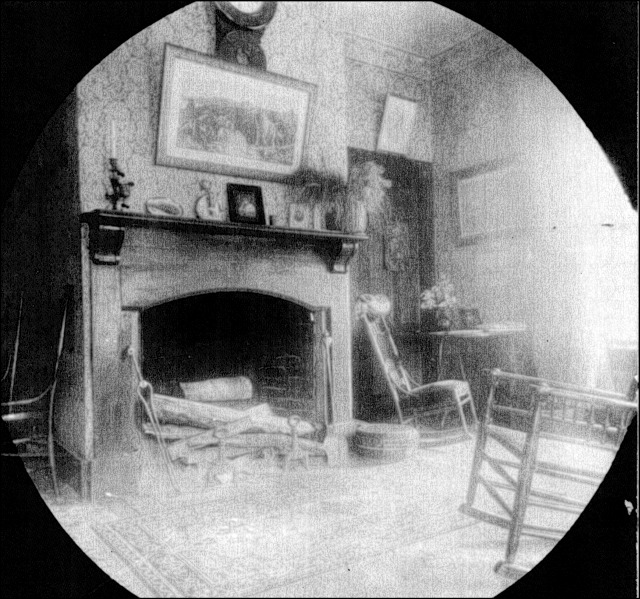
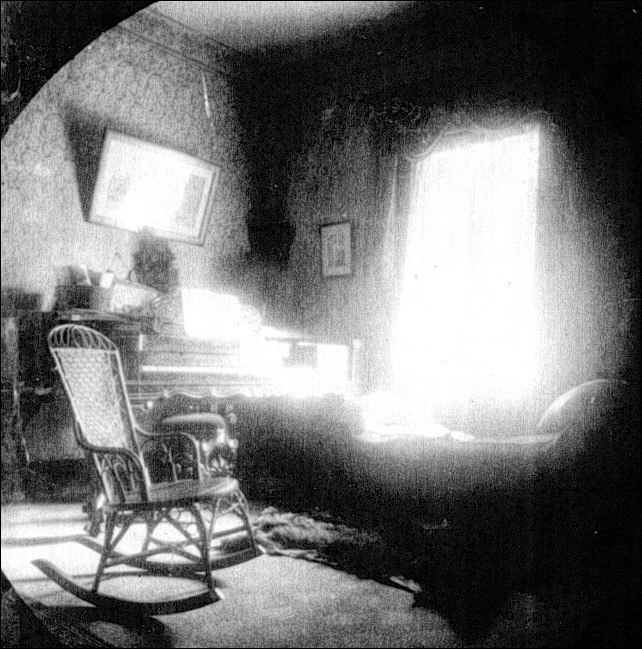
      The interior of the Cook house. These photos show a much better furnished home than any that were located in the upper Skagit River region in 1885. Ten years later, on Oct. 30, 1895, Nina Cook married Standish Budlong of Rockford, Illinois, in front of that fireplace.


Illustrated History of Skagit and Snohomish Counties, 1906
      The pioneer town builder did not arrive until 1884. This was Mortimer Cook, a somewhat eccentric man, but possessed of no little ability to win success in the commercial and industrial world. In 1885 he opened a general store in the first building erected in what later became known as Sedro, of which structure David Batey has the distinction of having been the builder. It faced on what was afterward known as Water street. At the same time Cook purchased forty acres of land upon which the town was later platted. buying it from W. Scott Jameson, the Port Gamble mill owner, who had "scripped" it some time before. Mr. Cook's great ambition was to bestow upon the new town a name such as no other town in America should have, and if such could be found he cared little whether or not it was euphonious or elegant.
      He eventually concluded to name the place "Bug," and even went so far as to direct that goods shipped from Seattle be consigned to that address. Mr. Batey painted the name on a sign which was then hung on the end of the building at the boat landing. One settler wished the town named "Charlotte," it is said, and went so far as to have a sign with that name painted in Seattle. About this time someone suggested that the syllable "hum" would probably be affixed by outsiders in jest; furthermore, Mrs. Cook and other ladies interested strenuously objected to the undignified name, and the founder of the town was prevailed upon to accept the name Sedro, a corruption of the Spanish word for cedar. Mrs. Batey is said to have discovered the name in an old Spanish dictionary she had and to have suggested it. Certain it is that the name is not only euphonious but very apt, as innumerable cedars of magnificent form grew originally on and around the site. Its peculiar spelling was adopted to satisfy Mr. Cook's insistent desire for uniqueness.


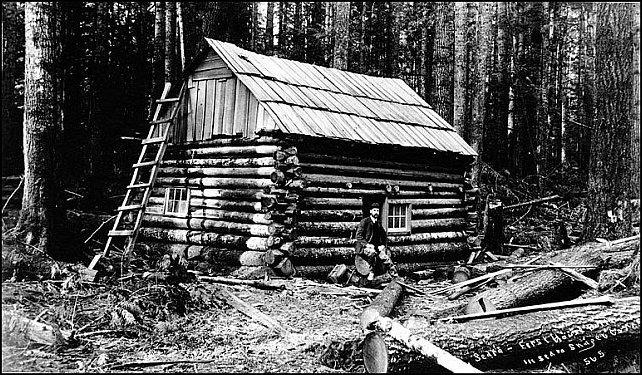
(First house in Sedro)
      Years ago, the late Howard Miller showed me this copy below of what was one of the earliest photos of the future-Sedro area. A handwritten caption on the photo reads: "First house built in Sedro, Skaget Co., Wash." By good fortune, the University of Washington Special Collections has the original (number WAR0593). They note that the photo was taken by Arthur Churchill Warner, who had a lengthy career in Seattle. You can read more about him in the caption for this same photo at the basic Journal website about the history of Sedro-Woolley
      Unfortunately we have not been discovered where the cabin was or who it belonged to. According to the UW, the photo could have been taken in either 1884 or 1894, but we lean towards the earlier date. The cabin could have belonged to any of the four British bachelors who homesteaded the future acreage or Sedro — Batey, Dunlop, Hart and Woods. Or it could have been David Batey's first cabin that he built near the Skagit River before he built his 2-story house a mile north on the bench. Or it could have been the cabin built by Lafayette Stevens at future Sterling, circa mid-1870s, or it could have been the one that Jesse Beriah Ball built near his mill at Sterling. Just like with the derivation of the name, Sterling, we may never know.


Illustrated History of Skagit and Snohomish Counties, 1906
By Eliza Van Fleet, written Dec. 10, 1900
      Mortimer Cook came to us in 1884 and employed Mr. Batey to build a residence and store and made arrangements to apply for a post office and christen the place Bug.
      I did not like the name, so persuaded several of our neighbor women to go with me and talk to Mr. Cook about it. We found him seated on a pile of lumber, whittling. We told him we had lived here several years in peace and quiet and had come to protest against his calling the new post office Bug. After scratching his head a while he remarked,
      "Don't suppose you ladies will sign my petition for the post office then?" I replied, "Never. How would letters look addressed to Bug?" He said that he had just received a letter from his wife in Santa Barbara, that she didn't like the name and was afraid it would soon be changed to Humbug; further, that she didn't think she would come home until the place had a better name.
      "Well," he said, "seeing Bug didn't suit the ladies the name shall be changed." The next time I saw him he asked how the name of Sedro would do, said it was the Spanish word for cedar. We all thought it a very good name so our post office was named Sedro. I sometimes wonder if our town would now be called Bug-Woolley had the name not been changed.


Journal research
      We want to thank the late Barbara Budlong Taggart of Rockford, Illinois, for supplying copies of these photos that show Cook's residence and store. She was 93 when we met her back there and she was a daughter of Nina Cook Budlong. She never met her grandfather, but she kept many mementos of his life and career. And we want to thank Deanna Ammons for taking the time to read hundreds of pages of old newspapers on microfilm. This is the only reference we have found so far to the town of Bug in any of the newspapers of the time. Besides the details of their house, we were especially interested to learn that the house was built before Cook's general store.
      One item that we dispute is this line from the 1906 Book "Mrs. Batey is said to have discovered the name in an old Spanish dictionary she had and to have suggested it." Mortimer was long gone by the time that was written. He died in Iloilo, the Philippines, on Nov. 22, 1899. If he read that line above, I am certain that he would point out that he lived in Santa Barbara, California, for 13 years, and served as mayor there for two terms, while Mexican Spanish was spoken widely. I suspect that he knew that language well enough that he did not need to be shown a Spanish dictionary. The source above, and others who have repeated that Mortimer's wife, Nan, was already living here when Bug was named, were obviously mistaken.
      That Mortimer originally named his village Bug is not all that surprising. First, he was always eccentric, dating back to the time that he hitched his plow horses to a fence post and left his parents' Ohio farm to enlist for the Mexican-American war. Second, the mosquitoes in the swamps around the town were often described as being the size of bats. Although the swamps are drained now and they aren't that big anymore, they are still annoying in the hottest days of summer. Naming the town for the cedar tree is also quite natural. There were hundreds of them all over the swampland that became Sedro-Woolley. Here are two examples from that time of the Paul Bunyan dimensions of those cedars.

      A cedar cut on Mortimer Cook's place at Bug measured 285 feet in length, 6 feet in diameter; 25,000 shingles were made from half of it. — Skagit News, April 28, 1885

      A big cedar on W.A. Dunlap's place above Sterling is by actual measurement 48 feet in circumference five feet above ground. Its height is estimated at 250 feet. Some idea of the size of this can be got by taking a good-sized settler's cabin, which would be 12x16 feet. — Skagit News, Oct. 14, 1884

      We communicated with the U.S. Postal Service and they sent us pages from the Alphabetical List of Post Offices, dated Jan. 1, 1886. Come asserted that Cook wanted to name the town for himself, as P.A. would do so a mile to the northwest, five years later. The folklore was that there were other towns named Cook, so he was forced by the U.S. Post Office to choose another name. But there was no town named Cook in Washington territory at that time. So Cook apparently did not attempt to attach his name to the village, as the town of Cook's Ferry was named for him in British Columbia in 1861. There were five towns named Cedar in the U.S.; there were dozens that had cedar in their name. So it is not surprising that Cook would once again be original in his creation of a name. Mortimer was one of the most creative retailers in history. We have shared some of his advertisements that will illustrate this fact. He certainly knew Spanish from his time in Santa Barbara, California, where he had been mayor for two terms.

Links, background reading and sources

Story posted on Sept. 19, 2004, last updated March 26, 2005, moved to this domain April 20, 2008
Please report any broken links so we can update them


Getting lost trying to navigate or find stories on our site? Read how to sort through our 650-plus stories.
Return to the new-domain home page
Links for portals to subjects and towns
Newest photo features
Search entire site
(bullet) See this Journal website for a timeline of local, state, national, international events for years of the pioneer period.
(bullet) Did you enjoy this story? Remember, as with all our features, this story is a draft and will evolve as we discover more information and photos. This process continues until we eventually compile a book about Northwest history. Can you help?
(bullet) Remember; we welcome correction & criticism.
(bullet) Please report any broken links or files that do not open and we will send you the correct link. With more than 550 features, we depend on your report. Thank you.
(bullet) Read about how you can order CDs that include our photo features from the first five years of our Subscribers Edition. Perfect for gifts.

You can click the donation button to contribute to the rising costs of this site. You can also subscribe to our optional Subscribers-Paid Journal magazine online, which has entered its ninth year with exclusive stories, in-depth research and photos that are shared with our subscribers first. You can go here to read the preview edition to see examples of our in-depth research or read how and why to subscribe.

You can read the history websites about our prime sponsors
Would you like information about how to join them?

(bullet) Oliver-Hammer Clothes Shop at 817 Metcalf Street in downtown Sedro-Woolley, 88 years.
(bullet) Peace and quiet at the Alpine RV Park, just north of Marblemount on Hwy 20, day, week or month, perfect for hunting or fishing
Park your RV or pitch a tent by the Skagit River, just a short drive from Winthrop or Sedro-Woolley
(bullet) Joy's Sedro-Woolley Bakery-Cafe at 823 Metcalf Street in downtown Sedro-Woolley.
(bullet) Check out Sedro-Woolley First section for links to all stories and reasons to shop here first
or make this your destination on your visit or vacation.
(bullet) Are you looking to buy or sell a historic property, business or residence?
We may be able to assist. Email us for details.

Looking for something special on our site? Enter name, town or subject, then press "Find" Search this site powered by FreeFind
    Did you find what you were seeking? We have helped many people find individual names or places, so email if you have any difficulty.
    Tip: Put quotation marks around a specific name or item of two words or more, and then experiment with different combinations of the words without quote marks. We are currently researching some of the names most recently searched for — check the list here. Maybe you have searched for one of them?
Please sign our guestbook so our readers will know where you found out about us, or share something you know about the Skagit River or your memories or those of your family. Share your reactions or suggestions or comment on our Journal. Thank you for taking time out of your busy day to visit our site.

View My Guestbook
Sign My Guestbook
Email us at: skagitriverjournal@gmail.com
(Click to send email)
Mail copies/documents to Street address: Skagit River Journal, 810 Central Ave., Sedro-Woolley, WA, 98284.