New portal section for
Pre Sedro and old Sedro/Bug by the river
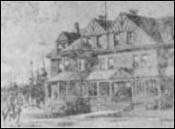 | Hotel Sedro, 1890-97.Click for early photos of Sedro. This is the architect's drawing for the Hotel Sedro, built in 1890 in new Sedro where the high school gym stands today.
|
New Sedro
- Junius Brutus Alexander, the son of a grocery magnate in Brooklyn, became the prime mover behind the merger in the 1890s as a leader in the Twin Cities Business League. Includes photos of the family's New York property and the story of the Honeymoon Cottage.
- Until we found the Dec. 5, 1891, issue of the Skagit County Times from old Woolley, we did not know there was an attempt to consolidate Sedro and Woolley in 1891. Read the full story and the Woolley city attorney's opinion that shot down the idea for seven years.
- Obituary for Norman R. Kelley, who literally drank himself to death in 1894 after founding new Sedro in 1889 while he was a right-of-way agent for the Seattle Lake Shore & Eastern railroad.
- Photo collection of old Sedro, new Sedro and the Cooks.
- All new logging and mills section. We have updated eight stories about early logging and mills, from 1876 logging to the Dolbeer steam donkey. Newest completely updated story: the Goodyear -Nelson mill. Coming soon: the Willis, Rogers and Pearson mill of Sedro-Woolley.
Old Woolley
- Two-chapter profile of P.A. Woolley and his family and his company town, including part two, about how his Woolley town was born, how Metcalf Street was named, Dr. Harbaugh's marriage into the family, how the family moved their business to Savannah, Georgia, and much more.
- Until we found the Dec. 5, 1891, issue of the Skagit County Times from old Woolley, we did not know there was an attempt to consolidate Sedro and Woolley in 1891. Read the full story and the Woolley city attorney's opinion that shot down the idea for seven years.
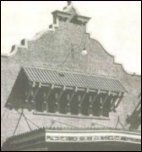 | Dream Theater 1917
built by Dad and Ben Abbott. Click on photo for story
|
- Part One of the Bingham bank and family story, which includes: Binghams arrive and open bank in old Sedro on July 30, 1890; Roots in Marengo, Iowa; Go West, Young Man; Binghams and Holbrooks flexing their muscles in Sedro; Julia feathers the Bingham nest; Bingham follows the business tide to Woolley; Marengo, Iowa, transplants to Sedro and Woolley; Wedding of the decade and even more Renos emigrate. All four parts.
- Sedro-Woolley's Opera House (1898?-1972?), the Bowery Square and the building that became the Moose Lodge of Sedro-Woolley, fully updated from our recent newspaper research.
- See 6 rare old photos about the 3 trains in the famous 1890s Sedro-Woolley triangle
- King County Sheriff's Deputy George W. Poor is mistakenly killed by a U.S. Customs officer between Sedro and Woolley on July 26, 1891, while chasing smugglers of Chinese illegals.
- The Kelley Strip, the "DMZ" no-man's land that served as the border between old Sedro and Woolley town.
- Obituary for Norman R. Kelley, who literally drank himself to death in 1894 after founding new Sedro in 1889 while he was a right-of-way agent for the Seattle Lake Shore & Eastern railroad.
- profiles of Charles Villeneuve and his son-in-law John Lloyd. Villeneuve was also a pioneer earlier on the South fork of the Skagit and especially at Conway. We are moving all our original "stumpranchonline.com" features like this one to our new domain. This story will soon be updated and changed to this address. If neither file connects, please email us.
; are you a descendant? Please email).
- Charles Woodworth, long-lost but now-found namesake for Sedro-Woolley's street. And a Tacoma promoter.
- Seneca G. Ketchum, Part One, growing up in Ontario; family of 17th-century English immigrants, pioneer settlers of Toronto, Ontario, and businessmen of New York State. All updated in 2009, and will be updated again soon with much more Ketchumania.
- Seneca G. Ketchum, Part Two, Woolley editor and Tramp Printer in Pacific Northwest, arrived in Washington Territory in 1888.
- Obituaries and articles about Seneca G. Ketchum and family.
- Introduction to Darius Kinsey, Sedro-Woolley's most famous photographer; he lived here from 1897-1906. Also includes information about the complete Kinsey collection at the Whatcom Museum of History and Art and links to other Journal Kinsey stories and other background sources.
- Profile of Darius Kinsey, Sedro-Woolley's ace photographer who revolutionized photography of logging and the North Cascades. He lived here from 1896-1906 at the beginning of his career, before moving to Seattle and establishing his Timber Views studio. This story will soon be changed to this address. If neither file connects, please email us.
- The story of the Hammer, Green and Parker families who made such an impact on Sedro-Woolley and Lincoln, Kansas.
- Read about how the Froggy Orchestra entertained settlers around the swamp that became P.A. Woolley's original company town in 1890, and how that area north of the railroad tracks is changing today, becoming almost chic.
- Downtown Woolley's proposed Hammer Square park and its historical significance. See the link there for Arthur C. Seidell, who first made that corner famous, and the history of Sedro-Woolley Rotary and their legendary philanthropy.
- Attorney General James Metcalfe, namesake of Metcalf street in old Woolley and the man who pulled the strings to pave the way for P.A. Woolley's company town.
- An early version of the Skagit county fair from an 1896 story.
- Short features about old Woolley in the 1890s, including the promotion of the cheese factory in 1896.
- Woolley's classy hotel: St. Clair, which was renamed the Osterman House in the late 1890s, burned in 1909. The site of today's Gateway Hotel.
- Wild Bill Murdock, logger, owner of Mount Vernon's early Washington Hotel, bartender, first mayor of Woolley in 1891, Sedro real estate developer and ace practical joker..
- A profile of F.A. Hegg, old Woolley's premier grocer and one of our best-educated pioneers, story in two parts. With links to information and stories about his sons Bill, Pete and Fuzz and their relationships to other pioneer families. Also see the story about his son, Earl "Fuzz" Hegg, who gained fame with his Fuzzy Wuzzy grocery in Sedro-Woolley and was one of the most beloved of the pioneer grocers.
- Doctor G.A. Jones, a Wyoming transplant who settled in Sedro-Woolley in 1912 as a professional veterinarian and left quite a mark.
- The robbery of the First National Bank of Sedro-Woolley on Oct. 17, 1914. Includes layout of the town and businesses at that time, the crime wave of Summer 1914 and the True-Love bandit.
- The Woolley Grays. Jim Gray, builder of Woolley's famous Palace Saloon, and Blanche Gray, mother of the Sedro-Woolley Library. The story of the library from the beginning in 1899 through the Carnegie library.
- Arthur C. Seidell, the man who helped capture Jefferson Davis and then built one of the first substantial buildings in old Woolley town.
- The Dream Theater in Sedro-Woolley and Dad Abbott, the impresario who built it and the original Chevrolet garage across the street, daughter Emma Abbott Ridgway, grandson Hugh Ridgway.
- Emil Runck and his bicycle shop, how he introduced the Harley-Davidson motorcycle to Skagit county, plus Ewestern Reno and the history of the bicycle.
- The strange story of the feud between brothers, the Sedro-Woolley and Sterling pioneers, the Ratchfords, Ritchfords and Richfords.
|
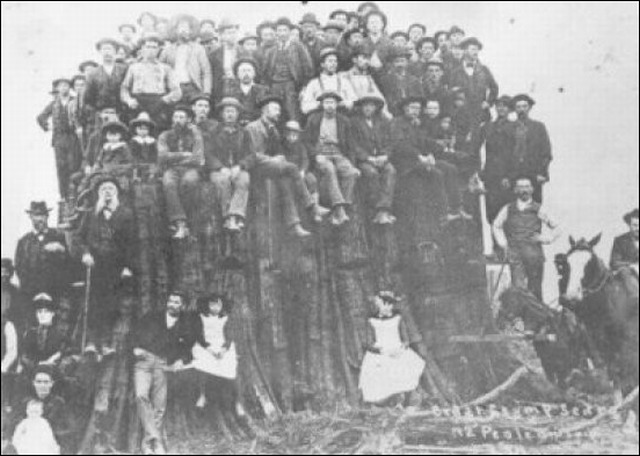
In 1892 a few dozen citizens from old Sedro and new climbed on top of a stump at 8th and Fidalgo streets, where Frank LaRoche Sr. photographed them.
|
- 3-part profile of Sedro-Woolley's premier international industry, Skagit Steel & Iron Works and a profile of its founder, David G. McIntyre and his family.
- Our exclusive profile of McIntyre and his pioneer family. This story will soon be changed to this address. If neither file connects, please email us.
- 1929 Washingtonian magazine article in two parts, profiling the early growth of the company and how the McIntyre family took control of it. This story will soon be changed to this address. If neither file connects, please email us.
- Read our about how local businessmen took the ball into their own hands and raised the money to pay for the land and homes north of the original plant in 1953, actions that convinced Skagit Steel not to move away from Sedro. Woolley. This story will soon be changed to this address. If neither file connects, please email us.
- The Kiens brothers, who homesteaded north of Woolley in 1884. Their distillery, blasting powder factory, gold mine and Henry Kaiser. This story will soon be changed to this address. If neither file connects, please email us.
- The fire of July 24, 1911 that leveled half of downtown Woolley — with photos of the aftermath. And then read how Woolley was rebuilt from 1911-13, also with many photos — the birth of our brick downtown.
- Larry Spurling shares another of his wonderful stories of his pioneer family, this one about the Glider on the Fourth of July and the outhouse that got in the way. Also see photos of floats in early-century parades.
- The Rockport Hotel Fire of 1952, a profile of its owner Hugo Bauman, and memories of Will D. Jenkins. Bauman originally owned the Osterman House hotel in old Woolley, which burned and was replaced by the hotel now called the Gateway. This story will soon be changed to this address. If neither file connects, please email us.
- The late Harold Renfro, longtime Sedro mail carrier and son of the family who moved here from Missouri at the turn of the century.
- The Pigg family, who moved in 1900 from Missouri to Sedro-Woolley, including W.B. Pigg, his confectionery and bakery, and his son Vic, first semi-pro baseball star from the high school. From our original domain, this story will be updated soon and have a new web address.
- The Paul Rhodius, Sedro-Woolley pioneer druggist, florist, gold miner, postmaster and baseball coach, who moved to Woolley in 1900. From our original domain, this story will be updated soon and have a new web address.
Consolidation of Sedro and Woolley
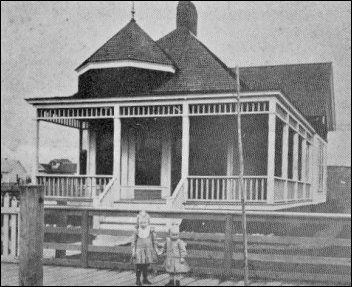 | The LaPlant house, known by many as the honeymoon cottage, or the Blue Cottage, stands at the northwest corner of 5th and Talcott streets. Boomer Junius Brutus Alexander built the house in 1892-93.
|
- Timeline of Sedro and Woolley through the merger in 1898.
- Until we found the Dec. 5, 1891, issue of the Skagit County Times from old Woolley, we did not know there was an attempt to consolidate Sedro and Woolley in 1891. Read the full story and the Woolley city attorney's opinion that shot down the idea for seven years.
- Woolley pioneer Ambrose B. Ernst, publisher of the Skagit County Times in 1891-92 and promoter of the merger of Sedro and Woolley. These is the first recorded glimpses of P.A. Woolley's company town from 1890, including his letters. Includes Ernst's later role as father of Seattle parks and his park dedication set for Sept. 12.
- We analyze a myth about the acceptance in 1898 of Sedro-Woolley as the name for the merged town, which includes the story of how a pioneer ate the deciding ballot.
- Jessie Odlin's 1898 poem about the merger of Sedro and Woolley. Our updated story with a passel of connections to Ivar's Acre of Clams, The Old Settler poem of 1870 and the much beloved song, Old Rosin, the Beau. This story will soon be changed to this address. If neither file connects, please email us.
Sedro-Woolley after World War I through World War II
- Can you even imagine losing the use of both arms and a leg in childhood and growing up to be a violinist and avid deer hunter. Read how Sedro-Woolley violinist Floyd Maxwell bagged his fifth deer. And read our transcription of two pages from the Dec. 1, 1949, issue of the Courier-Times, which includes photos and details of the severe flood, and especially how it affected old Sedro, the Nookachamps and Hamilton; plus history of the Wildcat Steelhead Club, the first Great Northern passenger in 17 years; plus several more stories. This story will soon be changed to this address. If neither file connects, please email us.
- Dollar Way in Sedro-Woolley, the first paved highway in the county, which Stone & Webster built as a demonstration project to earn the right of way for the Interurban. This story will soon be changed to this address. If neither file connects, please email us.
- The original Oliver Hammer Clothes Shop business and building, founded in 1921.
- While working on a history of the McIntyre family, we have developed an extensive timeline concerning the birth of Sedro-Woolley Iron Works and Skagit Steel & Iron Works. This is a major exclusive feature, which will lead you to links of other stories about the company and the McIntyre family. We also finally answer the legend that Henry Ford visited Sedro-Woolley in the 1920s.
- Did you know that Skagit Steel nearly moved away from Sedro-Woolley in 1953? Read Part One of the story of how local businessmen insured that the company would stay and expand.
- The J.J. Conner family moved West from Tarheel country in the Great Smoky Mountains area of North Carolina and Tennessee in the early 1900s. Read family memories plus a gold mine of Tarheel names in a book about the area back there. This story will soon be changed to this address. If neither file connects, please email us.
- Lloyd Palmer. The obituary of an old friend and descendant of Sedro-Woolley pioneers. Our memories of this fine nonagenarian and memories of his friends and family. Lloyd's father owned a series of trucking and logging businesses and Lloyd was a master mechanic for the Ford dealership in Sedro-Woolley, under Emil Jech, Sig Berglund and Vern Sims. Also included: the story of the Palmer Garage, Donnelly Motors, Coffland Garage and the construction of the Burlington Highway in 1932.This story will soon be changed to this address. If neither file connects, please email us.
- The Castle Tavern, a Sedro-Woolley landmark for 71 years and the last tavern in town, has closed forever in its location and was replaced on April 21 by the all-new Cues and Brews. It began as the Vienna Castle Bakery in the early 20th century
- Ku Klux Klan in Sedro-Woolley 1920s, and an overview of the KKK in Washington state and nationwide.
- A whole section about the Territorial Daughters, formed in Sedro-Woolley in 1936; includes information about how you or your descendants may qualify.This story will soon be changed to this address. If neither file connects, please email us.
- Loggerodeo, the celebration that put Sedro-Woolley on the 4th of July map starting in 1948, photos from the first Loggerodeo Grand Parade plus 4th of July festivities in the city and county dating back to 1880. Also see the photographs of the first Loggerodeo Parade of 1948, which were taken by the late
Bert Webber who died in 2006 in Oregon after a long publishing career there.
- H. Bean Hardware of Sedro-Woolley, Harry and Mort Bean and the Sanders family. This story will soon be changed to this address. If neither file connects, please email us.
- Central Grocery of Sedro-Woolley dates from 1917 and was the oldest surviving original grocery in the county until it closed in 2003. This story will soon be changed to this address. If neither file connects, please email us.
- Greg Platt of Sedro-Woolley promotes the 35-cent breakfast with his Hashbrowner.
- Travis Coulter bought the old Vern Sims Ford Ranch in 2003 and renamed it North Cascade Ford. History of the county's longest continuous auto dealership, dating from 1910. This story will soon be changed, and updated eight years later, to this address. If neither file connects, please email us.
- Jon Jech, grandson of early Ford dealer Emil Jech, wrote a special poem about Hart's Island, which we moved to this new domain.
Modern Sedro-Woolley since World War II
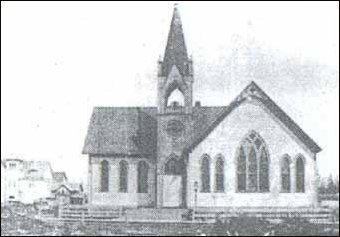 | The original Methodist church in Sedro-Woolley, which was burned down by an arsonist in the 1970s. This photo is from 1905.
|
- The Two-Spot Lokey at the entrance to Woolley. Puget Sound & Baker River Railroad's logging legacy welcomes visitors.
- Gertrude Sawyer, nurse and matron at the old Memorial Hospital in Sedro-Woolley.
- Howard Miller of Sedro-Woolley, 1915-2000
- Sedro-Woolley Fire Truck 2, dating from 1938, has been found in Whatcom County. Read about how you can help the Fire-fighters Association purchase and restore the truck.
- Harry Osborne Memorial Park in Sedro-Woolley, the 900-year old slice of Douglas fire there and the Two-Spot locomotive. And a Harry Osborne biography and memories of him. Do you have any memories, documents or photos that would add to the story?
-
Sedro-Woolley Museumand other area museums. That story will soon be changed to this address. If neither file connects, please email us.
- The Sedro-Woolley Museum presents their wonderful new Photo History of Sedro-Woolley book. Obtain it there at the corner of Murdock and Woodworth or at historic Oliver Hammer Clothes Shop downtown. This story will soon be changed to this address. If neither file connects, please email us.
- The Sedro-Woolley Museum has lost its guiding hand, R.I.P. Kerry Freeman. The Museum folks are carrying on his absence, hosting at the museum downtown on afternoons from Wednesday through Sunday and Saturday mornings. This story will soon be changed to this address. If neither file connects, please email us.
- History of Sedro-Woolley's Founders Days, which will celebrate its 18th anniversary the second weekend of September 2011
- During Founders Days the 1914 First National Bank robbery is reenacted as the city's most famous bank robbery, but the Bingham Bank was robbed in 1933 and people are still alive who remember the sadness that gripped Sedro-Woolley when night watchman Carl Strom of Utopia was murdered.
Churches, organizations, lodges and fraternal groups
- History of the Sedro-Woolley Chamber of Commerce, which evolved from the Twin Cities Business League, the force behind the merger of the original towns in 1898. This story will soon be changed to this address. If neither file connects, please email us.
- Knights of Pythias, one of old Woolley's first lodges, launched in May 1891 and disbanded a decade ago. This story will soon be changed to this address. If neither file connects, please email us.
- Methodists of Sedro-Woolley and Skagit county, a history of the church since the days of the "Little White Church" in Seattle in the 1950s through the organization in the county in the late 1800s. This story will soon be changed to this address. If neither file connects, please email us.
- Itinerant ministers of Sedro. The beginning of our series on churches. We plan to cover each early town's churches. Please help us with stories and photos. This story will soon be changed to this address. If neither file connects, please email us.
Sedro-Woolley schools history
- Sedro Woolley High School's first graduating classes of 1904 and 1905 (well before the time of online university), including Guy Flaherty, future sports star of the University of Washington and future engineer on the St. Lawrence Seaway.
- R.I.P. Alcina Harwood. We have lost a dear personal friend, a longtime inspirational teacher in the Sedro-Woolley school district and descendant of the Hoyt, Boyd and Allen families. Alcina was born and grew up in old Montborne near Big Lake.
- Our three-part, exclusive history of Sedro-Woolley and area schools, dating from 1883, is no longer on the site, but is being completed updated with new information. Meanwhile, read history of Sterling School. This story will soon be changed to this address. If neither file connects, please email us.
Odds and Ends articles from old newspapers: Sedro-Woolley pioneers & businesses
- Odds and Ends about Sedro-Woolley No. 1 Our new section with a dozen short stories, including: Skagit County's Washington Governor Henry McBride and the wild and woolly 1884 election . . . Margaret Hammer, Cinderella Girl . . . Eagles hosts national meeting 1925 . . . Burlington Highway (now Hwy 20) paved 1939 . . . South Skagit Road begins 1939 . . . Shirley Temple visits 1938 . . . Last passenger train 1940 . . . 1st Tarheel Picnic 1939 . . . and many more. You may have read the articles about Jack Abramoff and his alleged crimes while employed by the Preston Gates law firm of Seattle. Did you know that the firm dates from 1890 and that McBride staffed the Skagit County office of the original Preston firm then years before he became governor? There is history behind current affairs and the headlines.
- Part Two, Odds and Ends short stories about historic businesses and buildings in Sedro-Woolley Link has been repaired, after 1937, including: Will T. West & Bingham Bank . . . Johnson's Radio & Appliance . . . Devener's Lumber, Massar Lumber, Undertaker . . . Mt. Baker Hardware . . . Affleck Brothers Anacortes — Mt. Vernon Stage Co . . . .McClintock's Drugs . . . Ed Bigelow butcher, bowling alley and Mr. Eagles Aerie . . . Mel Stone DeLuxe Barber Shop . . . George Hammer's store garden . . . Royce Crossman and Bob Mahaffie butchers and Tradewell Market . . . Jac Running grocery and Sousa band . . . Income Taxes
- Part One, Odds and Ends short stories about historic businesses and buildings in Sedro-Woolley, up to 1937, including: George W. White, variety store and obit . . . Gampp's confectionery . . . Livermore Ford Garage . . . Stop & Shop grocery . . . LaRoche photography; Green Globe confectionery . . . Binghm Park service station . . . Ludwick-Wuest first radios . . . Candy stores . . . Brossard eggs and chicks . . . Piggly-Wiggly and Fuzzy-Wuzzy grocery . . . Dream Theater . . . Donnelly Motors and Cheese Factory . . .
- Part Two, Odds and Ends short stories about historic businesses and buildings in Sedro-Woolley, after 1937, including: Will T. West & Bingham Bank . . . Johnson's Radio & Appliance . . . Devener's Lumber, Massar Lumber, Undertaker . . . Mt. Baker Hardware . . . Affleck Brothers Anacortes — Mt. Vernon Stage Co . . . .McClintock's Drugs . . . Ed Bigelow butcher, bowling alley and Mr. Eagles Aerie . . . Mel Stone DeLuxe Barber Shop . . . George Hammer's store garden . . . Royce Crossman and Bob Mahaffie butchers and Tradewell Market . . . Jac Running grocery and Sousa band . . . Income Taxes
- Part Three, Odds and Ends short stories about historic businesses and buildings in Sedro-Woolley, after 1946, including: Central Grocery . . . Cascade Cafe . . . Ponschock tailor Linstrom & Jebens . . . Rogers-Romer Union Oil . . . Coffland Motors, Kaiser-Frazier autos . . . Palace Tavern and Jim Gray . . . Lee Tresner upholstery . . . George Shelton's ice-cream shop . . . Ted Jackson's service station . . . Ilo Sande Jewelry . . . Byham Cabinets . . . Skagit River Motor Lines . . . Pete & Bob's cafe
- Our Wish List: Copies of photos, documents and articles that we would like to see . . . donated computer items we need . . . names searched-for that we are tracking.
- Read more about what's new in historic Sedro-Woolley today.
|
 ,
, 
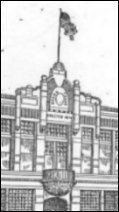 New Sedro 1890
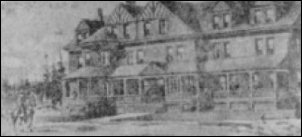 Hotel Sedro 1890

