Site founded Sept. 1, 2000. We passed 2 million page views on Oct. 4, 2007
The home pages remain free of any charge. We need donations or subscriptions to continue.
Please pass on this website link to your family, relatives, friends and clients.

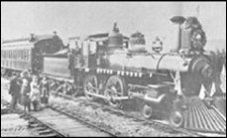
(S and N Railroad)

Skagit River Journal

of History & Folklore
Subscribers Edition
The most in-depth, comprehensive site about the Skagit

Covers from British Columbia to Puget Sound. Counties covered: Skagit, Whatcom, Island, San Juan, Snohomish & BC. An evolving history dedicated to committing random acts of historical kindness
Noel V. Bourasaw, editor (bullet) 810 Central Ave., Sedro-Woolley, Washington, 98284
Home of the Tarheel Stomp (bullet) Mortimer Cook slept here & named the town Bug

(Click to send email)

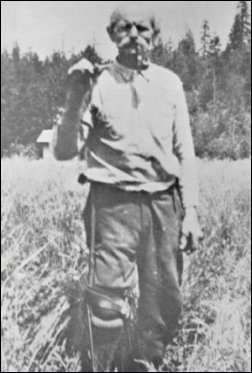
Amasa Everett cleared forests, farmed and gave birth
to the cement industry of Concrete, all on a peg leg

Shared from Issue 11 of our separate Subscribes Edition
This story is being updated in 2008. Can you help?

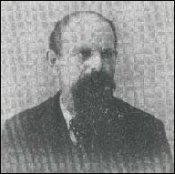
(Amasa Everett)
Amasa Everett, circa 1880s

      On an Indian summer September afternoon in 1874, Amasa Everett felt like he was on top of the world. He was on his way down Coal Mountain, on the south side of the Skagit river, descending to meet his fellow prospectors. He had very good news to tell them. He carefully laid down his hat, which held samples of bituminous coal that he found with very little effort. He was sprawled on the hillside, drinking from a cool, clear mountain stream when suddenly his world was shattered, as well as his leg. With no warning, a heavy boulder rolled over his right calf, crushing it. His Indian guide looked on with horror and then leaped down the trail to the place where they all planned to meet.
      When his two companions came back with the guide minutes later, they immediately sized up the situation. Everett was in shock and decisions had to be made quickly. Orlando Graham, a 48-year-old former first lieutenant in General William Tecumseh Sherman's division during the march to the sea across Georgia in the Civil War, saw many wounds and knew that this was a bad one. He quickly fashioned a splint from twigs and twine and a flat splinter from a tree and the men carried Everett slowly down the hillside to the canoe that they had poled up the Skagit that morning. If he was conscious and coherent, Everett may have instructed them about the splint, drawing on his own experience as a carpenter. Graham decided to accompany his friend and Indians who knew the river well, hoping that they could reach a doctor in time at Skagit city, the closest settlement, thirty miles downriver. Graham was doubly worried because he knew that two logjams impeded their travel 25 miles downriver a huge arching bend of the river near future Mount Vernon. When they reached the bend after dark that night, Graham knew they would have to build a primitive stretcher or sled and drag his friend two miles around the jams. He could see that infection was setting in and he worried whether Everett would survive the extreme trauma.
      Reaching the village of Skagit City at the fork of the Skagit near dawn, they immediately hired the son of a settler to run across the Swinomish flats to the nearest and only surgeon, George V. Calhoun. Graham shuddered at the thought that Calhoun might be out of town. Dr. Calhoun was a Union Army surgeon who hiked across the Isthmus of Panama at the end of the civil war on his way to direct the Marine Hospital in Port Angeles, Washington Territory. He also practiced in Seattle and he liked the delta of the Skagit, where he planned to move. In the event that Calhoun was not at LaConner, the runner was instructed to beckon Dr. John S. Church, the first physician to practice along the river back in 1873. But Church was not a qualified surgeon and besides, veteran Graham preferred the Army surgeons who witnessed hundreds of wounds even more serious than this one and knew how to size up the situation and act quickly. Later in the day Graham could see that time was running out. Then he heard a sound like an angel's trumpet. The horn of the Seattle steamer Chehalis blasted an ear-piercing shriek a few hundred yards away. What luck! It arrived on its once monthly run up the river. Graham bundled his friend onto the deck and implored the captain to expedite unloading his freight, take on the produce and furs in great haste and then set about immediately to dash back to Seattle. The captain agreed and they were on their way that afternoon.


From Maine to Minnesota to Washington Territory
      The three prospectors had met just a few months earlier when they were all working on Swinomish flats farms. Graham and Everett may have arrived together at LaConner the year before from Minnesota, their adopted state. Graham was a farmer, first in New York and then in Minnesota, until the Civil War fired him up with patriotic zeal at age 35 and he volunteered for the Fourth Minnesota Regiment. After four years of blood, then glory, following Sherman's lead in the march to the sea across Georgia, Graham returned to Minnesota at the close of the war and then emigrated to Fidalgo Island sometime in 1873.
      Everett was much younger than his companion and was from the far northeast corner of the U.S., upstate Maine, not too far from Dr. Calhoun's native New Brunswick. Born on June 3, 1849, as gold was being panned across the continent in California, Amasa showed no signs in his first three decades that minerals would play a major role in his life. His father, Lyman Everett, married Swiss immigrant Regina Sperry and Amasa was the youngest of four boys, the ninth of 11 children in the family. As is unfortunately true in many pioneer families, records of the daughters were not preserved. Lyman's father, Lyman Sr., and his brother Andrew came to America just before the revolutionary war and they were heirs back home to an estate, but they chose to enlist and fight for the colonies, which meant that their legacy was annulled. Mark Everett, Amasa's great-great-grandson, has studied the genealogy of the family and he discovered that Amasa's father worked hard as a logger in the Maine woods and was also a strong man in a traveling circus. Amasa also logged with his father and he also learned the carpentry trade.
      Amasa was born and grew up in the town of Washburn in Aroostook county. We have learned that the first schoolhouse in the town was built in 1859 along with a meeting house at the junction of the Blaine and Presque Isle roads. During the three or four years immediately preceding the Civil War the population of the town received quite an increase. The new Aroostook towns especially felt the severe drain of the war; their growth and development were stunted during the five years the boys were away. As we noted above, many people emigrated from the Maine-New Brunswick area to future Skagit county, one of whom preceded Amasa by more than ten years. Samuel S. Tingley was born in the nearby Aroostook town of Violet Brook and became a very early settler of the Day Creek-Happy Valley area south of the Skagit in the 1880s. He first came to Washington territory in 1859 as a government employee and helped build the revenue cutter I.I. Stevens. Thirteen years older than Everett, Tingley stayed on the Puget sound until the outbreak of Civil War when he returned home and enlisted in the 10th Maine Infantry. Everett was 15 at the time and we have not made a solid connection between the two men, but Tingley may have been the link that sent Amasa out here. After the war, Tingley lived in Pennsylvania and then shipped out to Pacific Coast around the Horn on the sailing ship, the Continental. Passengers included single women from Massachusetts, called the Mercer Girls, who sailed out here to meet prospective husbands since so many young men died in the war. Asa Mercer, son of a Seattle pioneer and president of the territorial university, dreamed up the expedition. Many wound up teaching school and softened the rough edges of the frontier in Washington territory. Tingley met Miss Maria Kinney on the ship right out of New York and they were married by the time they reached Portland, Oregon. Another important Skagit settler from the Aroostook area was Amariah Kalloch, who has a road named for him in the Prairie district, so he may have also been a link to Everett moving here. After the war, good times followed the return of peace back in Maine and immigration was encouraged so that population more than doubled during the decade from 1860 to 1870, but by then Everett was on the move west.
      When Lyman Everett died in 1865, Amasa took over his father's logging camp and ran it successfully for three years but he struck out for the forests of Minnesota in 1868, which is where he met Orlando Graham. We do not have any record of any of his siblings moving west with him. The Illustrated History of Skagit and Snohomish Counties [hereafter the 1906 Book] says that he worked there for three years but leaves a gap of 2-3 years before his first record in Whatcom county. He may have arrived here before 1873, but in that year he boarded in LaConner and then joined Graham and Stevens, working on a farm in the Swinomish flats area.


Upriver settlement and mineral discoveries

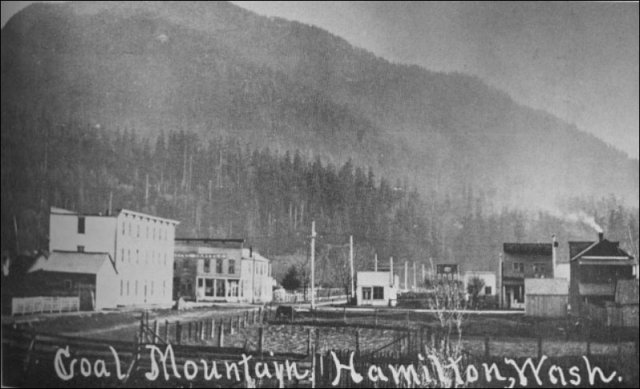
(Coal Mountain)
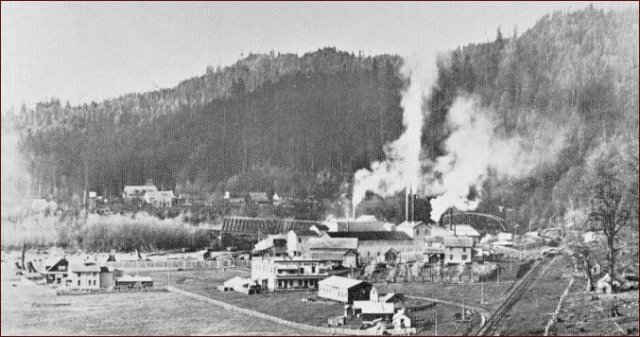
      This undated photograph was often printed on postcards near the turn of the 20th century. It is a truly a puzzlement, as people might have said back then, because most of the building are news to anyone who has seen the photo. We have no idea who the photographer was or what year the photo was taken, much less are we sure of which streets are crossing. At first, we thought that the view is looking south over the young town of Hamilton, with Coal mountain looming behind on the south shore of the Skagit river. That would mean that the streets are: diagonal-left-to-right — Cumberland Street, and horizontal — Maple Street.Or . . . are we looking west-southwest at the same streets, but switched in direction? We have begun to wonder about this because of the mountains in the background and the curved slopes of Iron Mountain and Coal Mountain. Just to confuse matters further, was this photo taken before the disastrous 1897 that wiped out the early town by the river — i.e., could the diagonal street be Cumberland and is the horizontal street, Water Street, which is now covered by the Skagit River? We hope a reader can identify when it was taken, in what direction and what the buildings are in the photo. This is truly one of the most mysterious and fascinating photos that have been passed down throughout the years.

      The first mention of Everett in local sources is in the 1906 Book. A subchapter on the early coal prospecting in the area notes that Everett and Graham arrived in 1873 and met Stevens while they all worked on the Swinomish flats the next spring. While boarding together in LaConner in 1874, the three men met some Indians who had come downriver to trade and showed samples of a strange yellow metal. LaConner pioneer James J. Conner apparently grubstaked the fateful trip upriver to find the source for what the men soon realized was gold. Conner's name would be associated with coal and mines here for at least the next 20 years. In late September that year the three adventurers paddled up to the long log jams at Mount Vernon, portaged around them — probably with Indian guides, and poled up to the future site of Hamilton. Stevens and Everett were intent on finding more of the placer gold, but Graham learned from Indians who lived there that they had found a peculiar black metal in the mountains across the river. Graham crossed the river with the Indians and when he came back he convinced his partners to change their prospecting plans for gold and explore Coal Mountain instead, a fateful decision for Everett.
      While Everett recuperated down in Seattle, the third member of the prospecting party — Lafayette Stevens, stayed behind and began promoting the coal ore they had found. [Read the Lafayette Stevens story.] Stevens was a wheeler-dealer in those days and an accomplished miner. Born in Illinois, he moved west across the county, winding up in California for a year and then learned the mining and prospecting business in the wild speculation days of Nevada. He came to the county about the same time as the other two and they valued his considerable skills. Several sources have conflicting reports about how the prospectors followed up on the coal discovery after Everett's accident. Some say that Graham actively promoted the coal discovery that year; others say that the three prospectors stopped prospecting during the usual wet winter and then set out again in the spring of 1875 with newcomer John Rowley. The latter reports say that they passed Hamilton and explored as far upriver as Marblemount and only after being disappointed did they return to Coal Mountain. Tough and determined, Everett fashioned a prosthesis during his recuperation and headed back for the river. He made a remarkable recovery and was extraordinarily agile for the rest of his life, as will be seen. Regardless of the timing, the partners set about organizing a mining company and finding investors who would grubstake the three partners and provide capital to hire labor and equipment to sink a shaft down into the mountain. Conner, who owned the LaConner House hotel where the original partners originally boarded, became a principal as did James O'Loughlin, a LaConner tinsmith who would also become a hotelier. Conner was a cousin of John S. Conner, founder of the town, and James suggested that his cousin use his wife's initials, L.A., to coin the name of the village. According to JoAnn Roe's book, Ghost Camps and Boom Towns, the partners incorporated on Sept. 18, 1875, as the Skagit Coal Co. for $960,000. Offices were established in LaConner and Stevens and his original partners were named as trustees, along with six other trustees, including Henry L. Yesler, who opened the first sawmill in Seattle in 1853. Conner recalled in 1906 that he originally dispatched the three adventurers on their trip upriver and said that he had first learned of the coal from an Indian chief. Everett also said in his own paid biography that Conner grubstaked the men.
      Now capitalized, the company filed upon 160 acres of coal land on the north face of the mountain and in 1875 the partners hired laborers to sink a shaft 100 feet deep. That first year, they shipped 20 tons of coal ore to San Francisco, which was growing rapidly and needed coal for heat and steam boilers. One must remember that there was no rail transportation for the ore, so it could only be shipped downriver by canoe. Working with Indians, the company took two large cedar canoes and strapped a jerrybuilt container on top and headed downriver. The log jams were 25 miles away and there was no way to hack a trail through the trees growing out of the jam, and the thick underbrush and twisted logs, so the men hacked a trail two miles around the jams to the west on the river shore, along the route they used the year before to transported the injured Everett. Once the trail was finished, they hired teams of Indians and a handful of local settlers to pack the ore on sleds to the southernmost end of the lower jam and they contracted the steamer Chehalis to carry the ore the rest of the way to bunkers in Seattle. The partners soon learned, however, that the added costs of shipping the ore that way cut considerably into the company's profits, so shipments slowed to a trickle. The mine subsequently remained undeveloped for two years until Conner gained other resources, promoted it again for a number of years, and ultimately sold or bonded the company to the Skagit-Cumberland Coal Co., a group of San Francisco and Seattle investors. Roe found a record that Everett sold his share of the claim to O'Loughlin and Conner in October 1875, and Stevens and Graham may have sold out, too, because we find no more record of their involvement in the company.


Everett settles near the Baker river
      At that point, the partners seem to have gone their separate ways. Graham became involved with promotion of Fidalgo Island as the terminus of the planned transcontinental railroad. The 1906 Book notes that Stevens staked a land claim at the site of future Sterling about the same time and subsequently lived there for the next ten years or so. The next record we have for Stevens after the Hamilton coal venture is in 1878 when he found a coal seam four miles northeast of future Woolley, at a site that eventually became known as Cokedale. Roe found a report in the archives of the Northwest Mining Journal that the Skagit coalfields were newer than the carboniferous age [about 280 million years ago] but older than the Cascade mountain range. "Geologists speculated that the Cokedale deposits were the same as that of Hamilton, and later geologists believed that the Hamilton, Cokedale, Blue Canyon, and large Bellingham coal deposits were all part of the same veins that extended northwesterly under the Georgia Strait to Nanaimo on Vancouver Island." Without rail transportation, however, the Stevens site presented more transportation problems since the mining claim was about six miles from the river and the forest was so thick on the route that even an average wagon ride took two hours. Besides, one of the logjams was still present downriver.
      Everett decided to strike out on his own, a very brave decision for a man with a peg leg. If that were not enough of a challenge, he would also do it alone. He told the reporter from the 1906 Book that he did not initially intend to take up land, but he soon built a cabin on the east side of the Baker river near where it empties into the Skagit, planning for it to be a headquarters as he prospected upriver. Rowley did the same at a spot on the south side of the Skagit almost opposite of Everett's claim. We find two references before 1875 to the spot that Everett picked. When the 1858 Fraser river gold rush petered out, most of the 10,000 miners who had camped out on the shores of Bellingham Bay left but one party under the leadership of Major John J. Van Bokkelen of Port Townsend explored Skagit river above the log jams and found the Baker river in the fall of that year. They followed it up a deep canyon through miles of swift water until they found a lake with Mount Baker behind. They noted the friendly Indians but they found no gold. In 1870 the Northern Pacific railroad dispatched a survey team to explore the feasibility of building a railroad across the Cascade Pass and down along the Skagit. The team was led by Daniel C. Linsley from Massachusetts and included John Tenant, an important Whatcom county pioneer, and Frank Wilkeson, who would make Skagit county famous in his New York Times columns 20 years later. On May 30 that year, they camped at the junction of the Skagit and the Baker, which the Indians called Novcultum, or White Water. Everett later spelled the Indian name, Nuhcullum. In the journal, Linsley wrote that the canyon presented no obstacle to the construction of a railway and that such work would not be particularly expensive. That was prescient.
      How Everett cleared the dense forest around his cabin, starting in 1875, has never been explained, but he must have been driven. After he cleared a substantial patch, Everett planted a garden each spring and it steadily grew and soon flourished. In one of the most humorous stories about the travails of settlers, David Batey and Joseph Hart, the settlers of future Sedro, bought a pig. The animal soon got loose and spent a few days dining on their seed potatoes, a delicacy that the settlers had obtained by poling 30 miles upriver to Everett's garden, three days up and one day back. Everett's ranch soon became a stopover point for prospectors and prospective settlers who traveled upriver. Everett and Rowley did not find enough placer gold to fund their supplies so the two men soon supplemented Everett's garden sales with wood products. Everett drew on his experience as a carpenter and soon the men cut cedar for cabin doors that sold downriver for $4 apiece and oars for $2 a pair. Everett adapted well to his revived life as a farmer and woodsman, but after Rowley participated in the gold prospecting trips in 1877-79 that led to the 1880 gold excitement at Ruby Creek, he grew restless. He abandoned his cabin and claim and Mr. and Mrs. Frank Hamilton took over the claim and received a patent for it two years later. That is now known as Ovenell ranch. Everett amassed enough capital by then that he was able to grubstake his friend Rowley's explorations as well as other prospectors. Continue to Chapter two


Links, background reading and sources

Story posted on Oct. 29, 2002 . . . Please report any broken links so we can update them
This article originally appeared in Issue 11 of our Subscribers-paid Journal online magazine


Return to the new-domain home page
Links for portals to subjects and towns
Newest photo features
Search entire site
(bullet) See this Journal website for a timeline of local, state, national, international events for years of the pioneer period.
(bullet) Did you enjoy this story? Remember, as with all our features, this story is a draft and will evolve as we discover more information and photos. This process continues until we eventually compile a book about Northwest history. Can you help?
(bullet) Remember; we welcome correction & criticism.
(bullet) Please report any broken links or files that do not open and we will send you the correct link. With more than 550 features, we depend on your report. Thank you.
(bullet) Read about how you can order CDs that include our photo features from the first five years of our Subscribers Edition. Perfect for gifts.

You can click the donation button to contribute to the rising costs of this site. You can also subscribe to our optional Subscribers-Paid Journal magazine online, which has entered its seventh year with exclusive stories, in-depth research and photos that are shared with our subscribers first. You can go here to read the preview edition to see examples of our in-depth research or read how and why to subscribe.

You can read the history websites about our prime sponsors
Would you like information about how to join them?

(bullet) Jones and Solveig Atterberry, NorthWest Properties Aiken & Associates: . . . See our website
Please let us show you residential and commercial property in Sedro-Woolley and Skagit County 2204 Riverside Drive, Mount Vernon, Washington . . . 360 708-8935 . . . 360 708-1729
(bullet) Oliver Hammer Clothes Shop at 817 Metcalf Street in downtown Sedro-Woolley, 86 years.
(bullet) Joy's Sedro-Woolley Bakery-Cafe at 823 Metcalf Street in downtown Sedro-Woolley.
(bullet) Check out Sedro-Woolley First section for links to all stories and reasons to shop here first
or make this your destination on your visit or vacation.
(bullet) Are you looking to buy or sell a historic property, business or residence?
We may be able to assist. Email us for details.
(bullet) Peace and quiet at the Alpine RV Park, just north of Marblemount on Hwy 20
Park your RV or pitch a tent by the Skagit River, just a short drive from Winthrop or Sedro-Woolley

Looking for something special on our site? Enter name, town or subject, then press "Find" Search this site powered by FreeFind
    Did you find what you were seeking? We have helped many people find individual names or places, so email if you have any difficulty.
    Tip: Put quotation marks around a specific name or item of two words or more, and then experiment with different combinations of the words without quote marks. We are currently researching some of the names most recently searched for — check the list here. Maybe you have searched for one of them?
Please sign our guestbook so our readers will know where you found out about us, or share something you know about the Skagit River or your memories or those of your family. Share your reactions or suggestions or comment on our Journal. Thank you for taking time out of your busy day to visit our site.

View My Guestbook
Sign My Guestbook
Email us at: skagitriverjournal@gmail.com
(Click to send email)
Mail copies/documents to Street address: Skagit River Journal, 810 Central Ave., Sedro-Woolley, WA, 98284.